

In today’s saturated digital landscape, standing out as a brand or subject matter expert requires more than just presenting facts and data. It demands capturing the attention and emotions of your audience through the age-old art of storytelling.
Whether you’re a business writer crafting marketing collateral or a technical writer documenting complex processes, incorporating storytelling into your online content can significantly enhance its impact and resonance with readers.
The Magic of Storytelling
Stories, the oldest and most powerful form of communication, have a unique ability to captivate and engage. As Cynthia Lockrey highlighted in her presentation “5 Tips for Impactful Storytelling” (American Migraine Foundation, June 29, 2023), stories are more than just a sequence of events. They are a vehicle for knowledge retention. Research suggests that they can boost retention by 2 to 10 times better than facts alone. But what makes stories so potent?
First, they engage the brain’s natural tendency for visualization, allowing readers to imagine themselves in the narrative’s circumstances. The personal aspect of this visualization helps the audience identify more with the storyteller (you or your organization) or character (an employee or customer).
Second, stories tap into the emotional centers of the brain, releasing dopamine and oxytocin – the neurochemicals associated with pleasure and interpersonal bonding. This alteration in brain chemistry, Lockrey explained, fosters a sense of relatability and empathy, making the content more memorable and impactful and creating a deeper connection with the audience.
When it comes to online content, the power of storytelling cannot be overstated. It’s not just about captivating audiences or conveying complex ideas; it’s about forging lasting connections with your brand or expertise. Jeff Bezos, who attributes much of his success to storytelling, once said, “You can have the best technology, you can have the best business model, but if the storytelling isn’t amazing, it won’t matter. Nobody will [engage].”
So, if you want your content to make a real impact, start telling stories.
The Basic Elements of Storytelling: A Conflict Resolved
At its meta heart, a story – spoken or recorded – is a journey you take your audiences on. It must answer a question or demonstrate a rationale for your business, product, or service.
The story itself must offer a compelling narrative. That means it should include three basic elements of conflict resolution, according to Christopher Davenport in his booklet “Nonprofit Storytelling for Board Members”:
- Character/Connection: Use 10-15% of your narrative to describe the main character in relatable terms.
- Conflict: Use the bulk of your narrative (75-80%) to describe the different types of conflicts that the character encounters. Include both external and internal conflicts.
- Conquest: Use 5-10% of your narrative to show how the main character’s circumstances were improved. This is your story’s wrap-up.
But these three C’s must carry emotional weight. As Johanna Walker described in her presentation “Mike Drop Moments: How to Tell Stories that Move Audiences to Action” (PMI Mile Hi Chapter, Jan. 11, 2023), a story must have an engaging beginning, risk, suspense, sticky details, an “Aha” moment, and a meaningful ending.
In the following table, I describe these elements and supply an example of each:

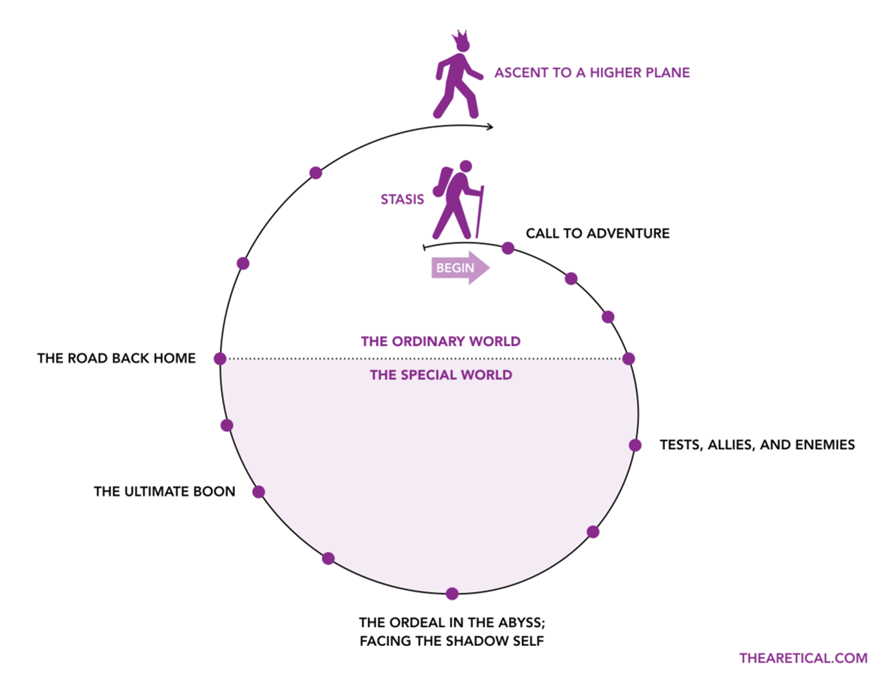
Walker underscores that many of these elements are part of the classic “hero’s journey” as described in Joseph Campbell’s The Hero with a Thousand Faces. That story pattern starts with the main character living one kind of life and, after working through a series of experiences, ending up living a different – hopefully, better – life. The classic example of this pattern is The Lord of the Rings trilogy.
The following graphic captures the “hero’s journey” pattern (used with permission from thearetical.com).
The Versatility of Storytelling: Content Choices
No, you don’t have to write a novel (or trilogy) to tell a good story. Storytelling in online content can take various forms, depending on the context, purpose, and audience needs.
Personal Anecdotes: These short, one-scene stories reference your personal experiences and can be particularly effective in blog posts, social media updates, and other informal content. They humanize your brand and create a sense of authenticity and relatability.
Testimonials: Short, first-person accounts from satisfied customers or clients, highlighting the benefits they derived from your product or service. Testimonials can be powerful social proof for your website, sales collateral, and online ads.
Extended User Case Studies: Longer narratives that showcase how a customer or client solved a problem using your product, service, or expertise. These stories position your offerings as the “hero” and can be compelling for product pages, whitepapers, and marketing materials.
Analogies: An extended, fictional example can be powerful for nonprofits because it invites the audience to put themselves into the same situation that a client might experience. Davenport suggests some ways to start an analogy to draw your audience in:
- “Can you imagine…”
- “Have you ever…”
- “What would you do if…”
In your online business content, you can use stories to explain or demonstrate:
- The origin of a business, service, or product
- The purpose of a project or proposal
- The value of a process, tool, or skill
- Your reasoning for a choice or direction
The Craft of Storytelling: Some Tips
To harness the power of storytelling effectively in your online content, consider the following best practices. (Some are sourced from ChatGPT.)
Know Your Audience: Tailor your stories to resonate with the interests, values, and experiences of your target readers. What challenges or aspirations do they identify with?
Be Authentic: Authenticity builds trust; ensure your stories are genuine and believable. Avoid embellishments or hyperbole that could undermine your credibility.
Keep It Concise: Adapt the length of your stories to fit the medium and keep readers engaged without overwhelming them. Social media posts may require micro-stories, while long-form content allows for more elaborate narratives.
Use Visuals: Enhance your narrative with relevant images, videos, and infographics. Visual elements can bring your stories to life and make them more engaging and memorable.
Edit Ruthlessly: Ensure clarity and coherence by editing out unnecessary details and focusing on the core message. A well-crafted story should flow seamlessly and captivate readers from start to finish.
Include Key Messages: To help maintain the audience’s focus, the story should convey at least one (up to three) key message. These core messages act as the narrative’s throughline, ensuring the details, characters, and events all tie back to the overarching points you want to drive home.
Respect Privacy: When including third-party characters and images, be sensitive about their exposure. Always check with others if you intend to mention them in a story, or use a pseudonym for the characters. Blur names in a screenshot or image, especially if they are not relevant to the story.
Strategies for Storytelling Across the Channel Spectrum
The point about adapting stories to fit the medium deserves additional attention. Here are some examples of how to apply storytelling techniques to various online content channels (some are sourced from ChatGPT):
Blog Posts: Start with a personal anecdote or case study to hook readers; then use a narrative to illustrate key points. You can also include testimonials or “user stories” to reinforce your messaging.
Technical Writing: Frame technical instructions or information within a scenario or use case to make it more relatable and engaging. Use customer success stories to demonstrate the application of technical solutions.
Business Writing: Incorporate brand stories to humanize the company and create emotional connections. Use storytelling in reports and presentations to highlight data through real-world implications. Share experiences and lessons learned from challenges and successes.
Social Media: Create short, compelling narratives that fit within the platform’s format. Use visual storytelling with images or videos to enhance the narrative. Engage your audience by encouraging them to share their own stories.
To help ensure that the story fits the context, audience, and channel, Johanna Walker advises that you ask the following questions:
- Would a story make a difference in this communication?
- Would the story move the audience to action in this circumstance?
- Could a story simplify this concept?
- Would a story help people to connect with the organization?
In the ever-evolving world of online content, storytelling stands as a timeless and powerful tool for capturing the attention and hearts of your audience. As Robert Olen Butler defined it, “Story is a yearning meeting an obstacle.”
When used strategically, storytelling can transform your online content from mere information into captivating experiences that forge deep connections. Embrace this powerful technique, and let your brand’s voice be heard through tales that inspire, enlighten, and leave a lasting impression.
(Image from Unsplash. Credit to Susan Q Yin.)
Discover more from DK Consulting of Colorado
Subscribe to get the latest posts sent to your email.
 DK Consulting of Colorado
One thought on “A Guide to Storytelling for Online Content”