
Technology services based on the representational state transfer (REST) architecture or a RESTful application programming interface (API) are becoming more important for hardware developers and content developers to understand. Wait, what? Why do I have to understand programming stuff? Read more
Category: Writing
4 Rules for Business Email – Rule #3
Is it too late to wish you all a Happy New Year?
OK. It’s been a while. There, I’ve said it. I started another writing gig in late December, and I have been remiss about updating this blog. And I am sorry. On the plus side, I get lots of opportunity these days to put my own words of wisdom into practice. (But, obviously, I am not above punning….)
So – Ahem – to review, here are my four rules for writing professional, business-like emails:
- Be Polite
- Be Professional
- Be Clear
- Follow up! (which is an outcome, really, of the first three)
Before the holidays, I got through the first two, so I’ll focus this blog on the third – Be Clear!

Clarity in emails, like clarity in crystal-ware, is a balance of ingredients. Lead crystal, also known as “flint glass,” is made up of silica and lead; traditionally, in fact, it was 24% lead oxide (which gives flint glass its refractive qualities but is not so good for the human nervous system). Lead crystal is still beautiful to look at. Waterford’s lead crystal chandeliers glitter ever on in Westminster Abby, and Waterford lead-crystal panels comprise the famous New Year’s Eve Ball in Times Square (see how I snuck that in there!). Lead-free crystal is also a balancing act, with various alternative oxides (potassium, zinc or barium) replacing the lead oxide.
Clarity in business emails comes from balancing straightforwardness (for lack of a better word) with brevity – with a little bit of good organization and audience sensitivity thrown in. In fact, a straightforward organization of your email is a good place to start. Always start with your ask and/or an introduction to your attachment. That is, lead (pronounce it “leed” in this sentence!) with your question or request or – if you are responding to another email – lead with your response and/or a brief phrase/sentence that describes your attachment.
Recently, a friend of mine was awkwardly caught up in a job-referral situation in which she wanted to ask a complete stranger for a job interview, having been referred to that stranger by a manager who had rejected her job application at his company (though he did so with great heart and positive feedback). She asked me to look at her email, which opened with a long complex sentence about her job qualifications. (For an example of a long, complex sentence, look at the first sentence in this paragraph!) She followed that with her question, requesting an interview.
I advised her to start the email with her question (since the email from the mutual acquaintance was attached anyway) and to follow that question with two sentences created from the overly complex sentence she had originally started with. Wallah! She secured the job interview and went on to win the job. Hurray! OK, her success probably can’t be solely attributed to her revised email. But I like to think I helped.
If your opening sentence (with your question/request or response/attachment-description) needs more context, then go ahead and provide it – but in a separate paragraph. You can even label that paragraph with the heading “Background,” “Clarification” or “Additional Information.” Here’s where audience sensitivity comes in. Most of the time, your reader will be interested only in (and read no further than) your ask or response. However, sometimes if – like me – they are overwhelmed with email and might have no clue what you are talking about, they need to understand the circumstances that compelled you to write the email. This is particularly true if you are rejecting a proposal or idea.
The idea here is avoid leaving the reader to guess about what you mean (“What the…?”) – or to guess about where you stand. Give him/her another sentence or three (depending on the situation) that provides some context for your opening phrase/sentence. Keep it brief, but be sensitive.
Example: How about lunch on Friday? I have news to share!
Response: Can we push to Monday? Have a big project due 1pm Friday.
While this simple exchange would have been fine minus the second sentences in each, the expanded versions let each recipient know that the relationship is valued (well, relatively speaking). Plus it sets up at least two topics of conversation for the ensuing lunch.
Which brings me to the fact that I am very hungry. OK, too much information – including too much information in an email – is never a good thing. So always circle back to the previous rules – be polite and, above all, be professional. No need for my email pals to know that my stomach is grumbling. I’ll spare them (but not you!) that detail.
Before I go on to my dinner (and sipping wine from a crystal decanter!), I’ll remind you that I have one more business email rule to define – Follow up!
4 Rules for Business Email – Rule #2
As a memory jog, here again are my 4 rules (guidelines) of business email etiquette:
- Be Polite
- Be Professional
- Be Clear
- Follow up! (which is an outcome, really, of the first three)
When I wrote about the first rule of business email – Be Polite – I suggested that you avoid email wars by requesting the use of a different communication channel (phone call, face-to-face meeting, facilitated meeting, water pistols at midnight, whatever). But if you absolutely, have to respond by email, please, please remember that you are responding to a human being, not a machine. Most human beings these days – at least the ones I know – are doing the best they can while facing tremendous personal and/or professional challenges. So please remember that.
And if you can’t remember that (really? It’s so hard?), then remember that nasty grams can live forever on someone’s hard disk drive. So be neutral, be sensitive, be smart and above all, be professional.
And that is our second rule of business email – Be Professional.
Email gurus Silberman and Johnson both remind us to watch the tone of our emails. Tone is a tricky thing. But believe it or not, it’s easier to moderate the tone of a written communication than it is sometimes to moderate the tone of our voice. (You can test this next time your cube neighbor douses you with a water pistol – how high and loud is your voice as you supposedly laugh it off?)
To moderate the tone of your emails, choose neutral words in place of more highly charged words. For example, refer to “status,” “open issues,” and “concerns,” not “debacles,” “problems,” or “mistakes.” While you might consider a shifting deadline to be an “issue,” it’s probably better not to refer to it as “missed” or “failed,” unless those words are used officially by your company or are generated by a software application – and you have your attorney sitting right next to you (holding a water pistol). People do take these labels personally, and you don’t want to wade into an inter-departmental (or inter-company) conflict unnecessarily.

Pushing into controversy myself a bit here (cue toe-in-water image), I’ll say that part of being professional is being sensitive to the person who was concerned enough about a topic to actually send you an email, especially if that someone is lower on the food chain than you. Being tough or clever or “above the fray” doesn’t always win the day; being appreciative and helpful can have more lasting effects (and remember, the email sender might not always be lower on the food chain).
(Note that I am not going to use the American idiom about catching flies with honey here, because, well, it’s gross and, besides, I’ve already used the term “food chain.”)
You know this, because you know it’s true in “real life,” too. I was reminded of this recently when I attended an evening public meeting in my community. Four professionals had formed a panel discussion on a specific topic. (I’ll be neutral here and not name the topic.) Toward the end of the evening, a woman in the audience stood up and asked specifically for help for her child. She was obviously emotional (though not overly so) but very sincere in her request. Not one of the panel members responded. Yes, you read that correctly, not even one.
Finally (to the relief of everyone), another professional in the audience stood up and offered to talk with her after the meeting. (At the same time, he acknowledged that he wasn’t sure that he was the best person to help her.)
How hard was that? Which one of the six people involved in this situation was the most professional, in your opinion?
OK, now I’ll take my toe out of the water, foot out of my mouth, water pistol away from my head, whatever, and talk about one last pet peeve about professionalism in business email. And that has to do with loooooooong email chains – the kind that cross weeks and even months on the calendar – or emails with multiple or hefty attachments. For the love of Mike, people, keep the context but ditch the heft! Mike, by the way, is the poor IT guy responsible for your company’s overtaxed email server.
So the last sub-rule is about professionalism when responding to a business email that’s been circulated through half the world: Be smart. Before you hit Reply All, make sure that all of the right people are on the distribution list; then delete and summarize any of the simple intervening replies (say, “the following people on the distribution list have already agreed”; then list them) and keep the original email as close on the page to your response as possible. Believe me, people will thank you (including Mike).
And I will thank you to keep reading my blogs on email etiquette (smooth, eh?). The next topic is business email Rule #3 – Be Clear.
4 Rules for Business Email – Rule #1
Yes, email is still around, and it is still the main form of official communication between business professionals. I realize that rules on email etiquette have been around as long as email has. Email etiquette guru Lindsay Silberman (author of several Email… manuals) has 25 rules for you to follow, and Dave Johnson of MoneyWatch has 9 “keys” for your pocket. But I think I can easily boil those down a bit more.
To start, we should all make one giant assumption in our 21rst century lives: Nothing you send in email will ever die. (This is borrowed from AIIM’s mantra: Nothing on the Internet ever dies.) Emails can be copied, pasted, forwarded, saved and (Hello, NSA!) archived in large data centers somewhere. I am not saying that you should abandon your free-speech rights at the entrance to the corporate campus, just apply your good-sense filters and “look both ways” before you hit Send.
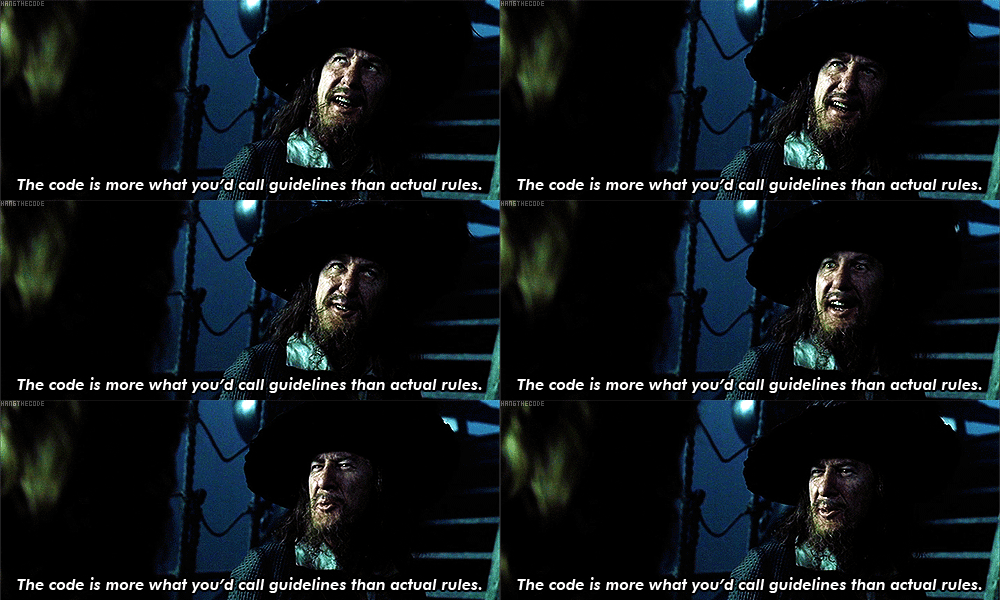
So really there is one overarching rule here: Don’t be stupid. Goes without saying that in the professional business world, you shouldn’t send obscene, rude, sexist, bigoted or otherwise offensive emails (nothing you wouldn’t want your grandmother or grandchild to see). So I think we can explore email etiquette by looking at only 4 rules – well, guidelines really:
- Be Polite
- Be Professional
- Be Clear
- Follow up! (which is an outcome, really, of the first three)
In this blog we’ll explore the first rule (guideline) and what it means – Rule One: Be Polite
Be Polite – I know this sounds as though I have turned in to my mother, and oddly, I found myself asking my 87-year-old mother the other night if she had been “polite” during a recent dinner at a neighbor’s home when she didn’t like the food. (The reasons why I asked this are deep and many, but I won’t overshare here.)
Translation to business email: Respond politely to whatever is put in front of you, even if you don’t like it and, most especially, even if you don’t like the person who put it there. The key here is to respoooooond, even if you simply say, “Thank you for your email. I’m sorry, but I am swamped right now. I’ll respond by noon tomorrow.” In fact, you can even set this message as an automatic response (using your email tool’s out-of-office feature) on days when you need some uninterrupted time at your real job – say, planning your next pirate-ship takeover. It will buy you some work time now – and some think time later. (Please don’t overuse this tip. And please do what you have promised to do – and follow-up!)
The main idea here is to say something that indicates you received the email (and thus convey to the sender that the email is not lost in the ozone somewhere). So thank the communicator, and/or acknowledge the meeting or clarification, and/or respond to the request. It doesn’t take most of us long to type, “Got it! Thanks.” Or “Thanks. I’ll be there.” Or “Thanks. I’ll discuss this with the team, and get back to you on N-day.” (Where N=the day you follow-up. More on follow-up with Rule 4, topic of a future blog.)
If the email you’ve received is itself impolite or contains provocative or otherwise unpalatable notions, rather than start an email war with cannons blaring, use your email response to set up another communication channel. You can always write, “May we talk offline about this?” to set up anything from a hallway conversation to a conference call. Or – and here’s a unique idea – take the initiative and pick up the phone to call the sender. (If it makes you feel better, you can throw in a pirate’s “Aaaaargh” somewhere in the conversation…see if they notice.)
One last note: It goes without saying here (again!) that you don’t always have to respond to every email. For instance, you do not have to respond to automated emails, or all-hands emails, or a similar widely distributed email. Use your good judgment (or your mother’s good judgment, whichever best applies).
Next blog – Rule #2 – Be Professional
10 Commonly Misused Words
http://hellogiggles.com/10-words-that-youve-probably-been-misusing
Well presented list here! Don’t be compelled to use the word “travesty!”
This is a reblog from “Written Rambles.”
There are so many words in the English language that it’s not surprising that the definitions for some of them have gotten mixed up over the years. It’s possible that you’ve gone your entire life without realizing your mistakes. I’m sure people have noticed. One day, you were probably walking down the street, casually chatting with an old friend, and one of these words slipped out of your mouth. Before you can move on to your story about how Mufasa would actually make a very attractive human, your friend stops to correct your error, and suddenly, your whole life starts to feel like one giant lie. How long have you been using that word incorrectly, you wonder? How many angry Facebook rants have you ruined with your improper grammar? While I can’t give you an answer to those questions, I can at least provide you with a list of other tricky words so that you may never have to suffer from this embarrassment ever again:
1) Travesty
What you may think it means: a tragedy, an unfortunate event
What it actually means: a mockery; a parody
This one, I’ll admit, is my own personal error. For the longest time, I equated travesty with tragedy, mostly because in passing, they sound like the same word. It’s stupid, I know, but if you knew how many times I confused fetal position with beetle position, you wouldn’t be laughing. It’s a serious problem.
2) Ironic
What you may think it means: a funny coincidence
What it actually means: contrary to what you might expect
It’s not ironic that you bumped into a talking turtle in a sweater vest right after you told your friend how cool it would be to bump into a talking turtle in a sweater vest. It’s a coincidence, and believe it or not, those two words are not related. Also, you should probably lay off the drugs because I’m pretty sure animals shouldn’t be talking.
3) Peruse
What you may think it means: to skim or glance over something
What it actually means: to review something carefully/in-depth
How this definition got completely turned on its head, I’ll never know, but I’ll be sure never to say “I’m going to go peruse my math textbook” ever again, just in case someone overhears and tries to hold me to it under the real meaning.
4) Bemused
What you may think it means: amused
What it actually means: confused
Again, with the whole “words sounding alike” issue. I’m starting to think I just need hearing aids. This is getting out of hand.
5) Compelled
What you may think it means: to willingly do something, to feel like you need to do something
What it actually means: to be forced to do something (willingly or unwillingly)
The word you’re looking for is “impelled.” I agree, it doesn’t get enough attention.
6) Nauseous
What you may think it means: to feel sick
What it actually means: to cause nausea
When you eat too much ice cream and declare to your mom or the nearest adult, “I feel nauseous,” what you’re actually saying is that you are causing people around you to feel sick. Thanks, jerk. (For the record, “I’m nauseated” is the way to go.)
7) Conversate
What you may think it means: to hold a conversation
What it actually means: ABSOLUTELY NOTHING
This word is a mix of conversation and converse, and doesn’t actually exist, like unicorns or YOUR DREAMS. (I’m kidding. Unicorns are totally real.)
8) Redundant
What you may think it means: repetitive
What it actually means: superfluous, able to be cut out
“Including this sentence is redundant because you already mentioned your love of Santa Claus in the previous paragraph.” This has always been my exposure to the word redundant, so it only makes sense that I would think repetitive was correct. I can’t be the only one? Right? RIGHT?
9) Enormity
What you may think it means: enormousness
What it actually means: extreme evil
I don’t know where the “extreme evil” thing came from (probably the Devil) but enormity makes more sense as enormousness in my mind.
10) Terrific
What you may think it means: awesome, fantastic
What it actually means: causing terror
Okay, so “causing terror” is more of an outdated definition but I still thought it was interesting. Maybe keep this fun fact in the back of your mind the next time you call your favorite camper, “Terrific Tommy,” because technically, a few decades ago, that might have been an insult. Unless instead of a camper, he’s a serial killer. In that case, go for it.
Info via DailyWritingTips.com, Cracked.com, and WriteItSideways.com.
 DK Consulting of Colorado