

When I created the Three-Force Audience Model for my July blog post, I focused on the endpoints.
The reader. The AI system. The community.
But afterward, I found myself thinking more about the spaces between them.
After all, these forces don’t operate independently. A reader asks an AI system a question. Someone brings the AI-generated answer into a professional discussion. That community discusses, challenges, or reinforces the idea and seeks further sources. Each interaction can change how information is understood—and what happens to it next.
That makes the spaces between the endpoints at least as interesting as the endpoints themselves.
So, for this follow-up, I went back to the Three-Force Audience Model and added arrows to represent the multi-way interactions among the three forces.
What they reveal is a more dynamic picture of today’s content environment—and some important implications for those of us who create and manage content.
How the Three Audience Forces Interact
The audience ecosystem I introduced last month should move us, as content creators, beyond the notion of a single audience type for our content. Instead, our content exists within an ecosystem shaped by three very different audience forces.
Given that, we must accept that there is no single type of interaction with our content—or even a single audience flow. Audiences interact with our content at any point along their journeys to or from it. As they do, they can add meaning that, in turn, can help us improve and even expand the original concept.
The arrows in the graphic below represent potential flows among the audience forces that act on our content, with each potentially influencing the others.
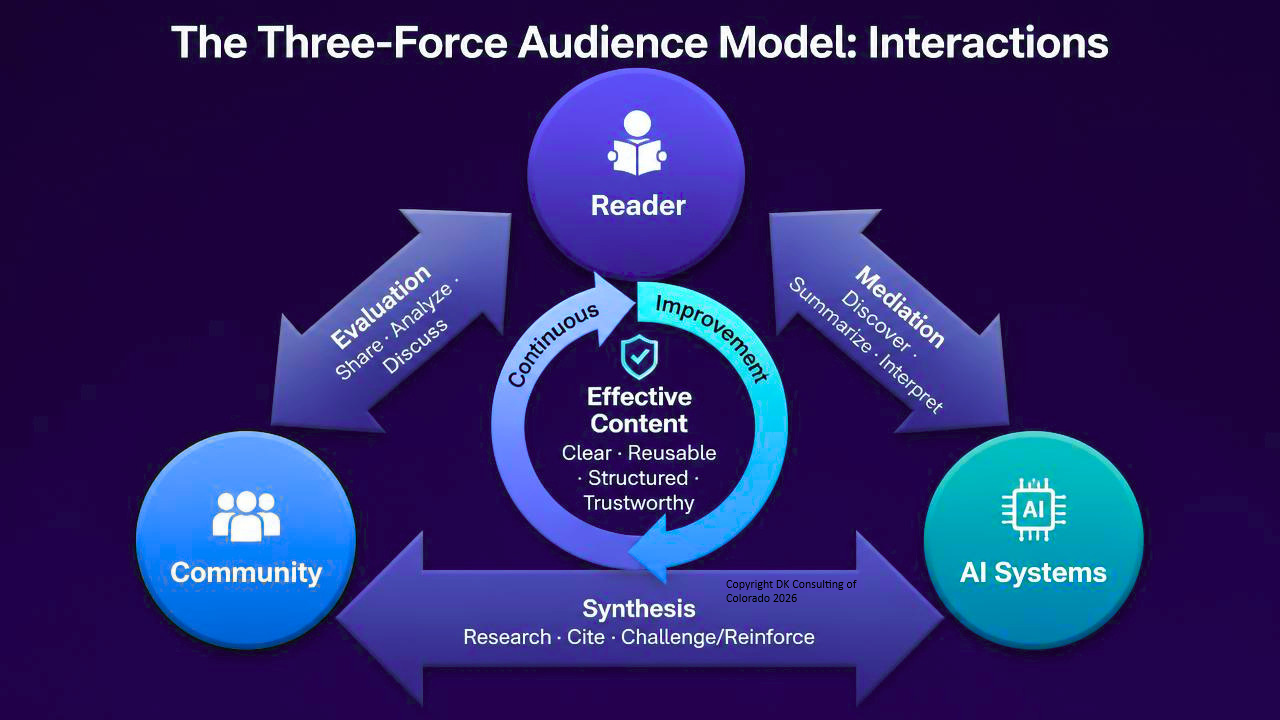
Looking at each flow individually reveals that each interaction with our content could serve a different purpose—or more than one—and that any of these interactions may recur over time.
Mediation: Reader to/from AI Systems
AI systems increasingly mediate how readers encounter online content. A reader might never begin with the original article, report, or website. Instead, an AI system might summarize your concept or interpret your content in response to a question. The reader can then refine their request, ask for more detail, view the source content, or pursue a different direction.
Thus, during a mediation-type interaction, AI might help the reader do any or all of the following:
- Discover content or ideas that address a question or need.
- Summarize content by condensing its main points or relevant details. (For tips on writing for AI summaries, review my November 2025 blog post.)
- Interpret content by explaining, comparing, contextualizing, or responding to follow-up questions.
In this relationship, AI becomes an intermediary between the content and the person engaging with it. But remember, the readers themselves have agency to judge what AI serves them. Thus, the reader-AI interaction can be a double-edged sword for content. (For more on human vs. AI agency, review my blog post “Agent vs Agency in AI Adoption: Framing Ethical Governance.“) As readers respond to AI interpretations, they may uncover ambiguities, missing context, or new applications of the original idea. Those discoveries can enrich the interaction but may remain opaque to the original content creator.
Evaluation: Reader to/from Community
Readers also evaluate content through their interactions with other people. After encountering a concept—whether directly from its source or through AI—they might take it into a workplace, a professional network, an online group, or another community. There, the content becomes part of a social process.
In that process, community members might encounter the original content only as a snippet or a contextualized link. Even when they encounter the entire piece, they might add context from their own experience, agree or disagree, or ask for evidence. In that sense, the reader-community interaction helps participants judge what deserves their attention and trust.
This interaction can also expose assumptions, identify gaps, or suggest ways to strengthen the original idea. If the content creators are also part of the community, these revelations serve as important feedback.
Within a community, participants might do any or all of the following:
- Share content they consider useful, interesting, or relevant to others.
- Analyze the content’s claims, assumptions, evidence, credibility, or potential applications.
- Discuss different interpretations and relate the content to their own experiences or circumstances.
Synthesis: Community to/from AI System
AI systems and communities both participate in a broader process of connecting information, evidence, and perspectives around your content’s ideas.
Communities create discussions, citations, critiques, and other material about your content. When AI tools encounter these new artifacts while retrieving information, they may incorporate some of that additional context, evidence, or disagreement into their responses. AI systems can then present new syntheses in response to future queries. People, in turn, can bring AI-assisted research and answers into their communities, where the generated information can be examined alongside other sources and perspectives.
Through repeated research, citation, challenge, and reinforcement, your content’s original idea can acquire additional context, evidence, interpretations, and applications. This synthesis can also amplify the idea, extending its reach and influence well beyond the original reader.
Within the community-AI interaction, any or all of the following might happen:
- Research the content’s concepts by seeking additional information, sources, evidence, and perspectives that provide greater context.
- Cite the content alongside relevant sources and ideas, connecting it to a broader body of information and evidence.
- Challenge or Reinforce the content as new evidence and perspectives reveal weaknesses, provide support, or suggest alternative interpretations.
Why the Fundamentals of Effective Content Still Work
The interactions among readers, AI systems, and communities mean today’s content environment is complicated. Yet the fundamentals of effective content haven’t changed nearly as much as the environment around them has.
In the center of the Three-Force Audience Model, I identified four qualities of effective content: clear, reusable, structured, and trustworthy. None is new. Content professionals have relied on these principles for decades. What has changed is the number of ways our content can be encountered, interpreted, evaluated, and combined with other information.
Clear. Readers have always benefited from content that communicates its meaning without unnecessary ambiguity. (For more about clarity in content, see my blog post “Creating Online Content for Your Customers: Clarity.”) Clarity becomes even more important when an AI system might summarize or interpret that content, or when a reader might share only a portion of it with a community. The farther content travels from its original context, the more important it is that its central ideas remain understandable.
Reusable. Content no longer must be consumed from beginning to end to be useful. A paragraph might appear in an AI-generated response. A colleague might share a single section with a team. A community might cite one idea in an entirely different discussion. Designing meaningful portions of content so they can retain their value outside the whole makes that content more useful across the ecosystem. In last month’s blog post, I referred to this concept as designing for modularity. It’s a concept I have championed for some time, as I noted in my earlier blog post, “Step One in Component Content: Common Modules.”
Structured. Structure operates at more than one level. For readers, descriptive headings, logical organization, and scannable formats provide guideposts for navigating and understanding content. Behind the visible content, taxonomies, semantic tagging, metadata, and consistent content models add another layer of structure, which identifies what the content is about and how its components relate to one another. Together, these forms of structure make content easier to find, manage, interpret, connect, and reuse across systems and contexts. That structure benefits human readers directly, while also supporting the systems and processes through which content is classified, retrieved, assembled, and reused.
Trustworthy. Credible authorship, appropriate sourcing, sound evidence, and transparency help readers decide whether information deserves their confidence. Those same qualities give communities something concrete to evaluate and give AI-mediated readers a path back to the original evidence. One important tenet here is that AI-generated content should be appropriately labeled so that readers know how to approach evaluating it. Ultimately, trust cannot simply be asserted; the content itself must demonstrate why readers should grant it. Note that I tackle some additional aspects of content trustworthiness in my blog post “Content Creation in a Time of Disinformation: A Pathway to Trust.”
These three sets of interactions in the Three-Force Audience Model don’t have to represent the end of the content’s journey. If we can capture—or even simply attend to—them, they can become inputs for continuous improvement. Questions may expose ambiguity. Discussion may uncover a missing perspective. Research may provide better evidence. Challenges may reveal a weakness—or reinforce an idea in ways the creator hadn’t anticipated.
The opportunity for content creators, then, is to consider the full life cycle of our content as it moves through the audience ecosystem—to learn from what happens there. The fundamentals of good content design help our content survive the journey; paying attention to the journey can help us make the content—and the ideas behind it—better.
How We Must Think Differently: Designing for the Journey
For content creators, publication has traditionally felt like an endpoint. We research, create, review, revise, and publish—and then move on to the next assignment.
The Three-Force Audience Model suggests a different way to think about that endpoint. Once published, our content continues its journey. Readers encounter and interpret it, communities analyze and discuss it, and AI systems introduce it into entirely new contexts. Moreover, the dynamic interactions among the three forces can alter, expand, or add context to the original concept. Thus, adjunct concepts, additional evidence, and new applications can emerge.
This ecosystem could give us something content creators haven’t always had: more opportunities to learn what happens to an idea after we release it. Finding ways to attend to that journey can help us clarify confusing passages, strengthen evidence, address unanswered questions, improve structure, or recognize that an idea deserves further development.
Perhaps that’s the most important implication of this dynamic audience ecosystem. We don’t need to reinvent the fundamentals of effective content for the AI era. We need to design content that can withstand the journey—and remain willing to learn from where it takes us.
Disclosure: The author used ChatGPT to assist with the initial drafting and final copyediting of the blog post. The author expanded and rewrote the final copy and takes full responsibility for it.
Discover more from DK Consulting of Colorado
Subscribe to get the latest posts sent to your email.

