

Thanks to a recent experience, I’ve been thinking about how the audience for my content has changed—and how, in some ways, it has stayed the same.
During a recent group book discussion, one of my friends asked me to characterize the university students I taught in the mid-1990s and compare them with today’s students. Those students lived in a very different information environment. Access to knowledge was slower, more deliberate, and often mediated through libraries, instructors, and printed materials.
Today’s students inhabit an ecosystem where information is abundant, instantly searchable, algorithmically recommended, and increasingly summarized before it is ever read.
These changes don’t simply alter how people consume information. They change what it means to be an audience.
The traditional idea of a content audience as a stable set of personas or demographic segments no longer reflects how people encounter information online. Today, content consumption is shaped by three interacting forces: the individual reader, the AI system that discovers, summarizes, or interprets the content, and the community that shares, evaluates, or discusses it.
This shift requires content professionals to think differently.
Read on to learn about these three forces and how today’s content creators and managers can best work with the emerging challenges:
- Three Forces Now Shape Content Consumption
- Beyond Designing for AI Summaries: What a Blended Approach Really Adds
- Solving the Audience Conundrum: What Content Professionals Can Do
- A New Focus: The Audience Ecosystem
Three Forces Now Shape Content Consumption
For decades, audience analysis began with a familiar question: Who is my audience? Whether writing a user guide, a white paper, or a blog post, communicators were taught to identify readers’ goals, knowledge, and expectations before choosing the appropriate tone, level of detail, and structure.
Those principles still matter. What has changed is the assumption that content is written for a single audience or audience segment.
Today, AI has become an intermediary between author and audience. Increasingly, readers first encounter an AI-generated summary, comparison, recommendation, or synthesized answer before deciding whether to engage with the original source. That shift fundamentally changes the work of content design because communicators are no longer writing only for the person who ultimately reads their work.
Content now exists within an ecosystem shaped by three interacting forces. Each force places different demands on your content:
- For the reader: Is this useful, understandable, and worth my time?
- For the AI system: Can these ideas be accurately interpreted, summarized, and connected?
- For the community: Is this credible enough to recommend, discuss, or build upon?
Successful communicators increasingly need to satisfy all three simultaneously.
Writing for the Reader: Human Authenticity
The human reader remains the reason content exists.
Facts are increasingly commoditized. Readers value interpretation, context, and judgment. Content that appeals to the reader in this way, if effective, can enhance trust in the source and lead the reader to further engagement and action, even to the point of developing brand loyalty.
Readability, intentional relevance, and a recognizable authorial voice [are] more important than ever.
That makes readability, intentional relevance, and a recognizable authorial voice more important than ever. Of these three, the authorial voice has become increasingly important. A 2023 MIT study notes that for the human reader, “there’s great benefit in knowing that humans were involved [in a piece of content] somewhere along the line.” In other words, good writing helps readers understand the content. A distinctive perspective gives them a reason to continue and even deepen their response.
That kind of authenticity is a different type of personalization. It puts the author back into the interaction with the reader. It invites readers into a relatable journey of understanding. Yes, use language and details that are familiar and relevant to them, but also give them a reason to engage both logically and emotionally.
(For more about readability, see my previous blog post “Chunking for More Accessible Online Content.” )
Writing for the “AI-verse”: Beyond Findability
While human readers remain an important target for content creators, AI systems (what I call the “AI-verse”) have become important intermediaries between creators and readers. Thus, they become a secondary force acting on content access.
The “new audience” includes intelligent systems as well as people.
But not always a positive one. Don Rua, citing a Pew Research study in a 2025 Digital Content Next, states that “When AI-powered summaries appear in Google results, users are 50% less likely to click through.”
This means that content professionals must broaden their thinking about audience engagement to include how AI interacts with their content, and vice versa. Beyond simply indexing pages for search or summarizing articles, AI systems can extract key ideas, compare sources, and influence which content is surfaced in response to a user’s question. This is how the term “AEO” or “answer engine optimization” has entered our consciousness.
Additionally, content professionals increasingly must be concerned with the emergence of AI agents. These AI tools compare products, recommend services, complete transactions, and perform other tasks on behalf of users. In those situations, your content serves a larger purpose than simply informing a reader. It may also influence decisions made by AI systems acting as the user’s representative.
In that sense, the “new audience” includes intelligent systems as well as people. “Business-To-Agent now joins Business-to-Business and Business-to-Consumer to form the future of content creation and consumption,” assert authors Gahun, Davidson, and Pattisall in a recent Forrester article. The authors call for rethinking content systems and operations.
But there is much to be done at the content design level, too. For content professionals, that means making ideas easier to interpret accurately when they are summarized, cited, or recombined.
Writing for a Community: A Value Multiplier
Community remains the third force acting on content because audiences still trust what is socially validated. We often evaluate information through our interactions with others. A community starts out as “a group of people who connect with each other around a shared interest in your product or domain,” explains Fareed Amiry in a blog post for bettermode. But active communities often evolve to become more than that. Relationships, shared knowledge, and the creation of value often happen within a cocoon of trust that develops within the group.
Creation of value occurs when a community decides that a piece of content is worth discussing, analyzing, recommending, challenging, or citing. In other words, the value of the piece increases the more it resonates within the group.
Communities can also influence how content is interpreted long after publication. Colleagues share useful articles. Industry experts endorse ideas they find credible. Readers return to authors whose work consistently provides value. These activities become your content’s legacy.
As AI-generated content becomes more common, these human signals of trust become increasingly important. Communities evaluate qualities that machines cannot easily measure: credibility, experience, practical usefulness, and authenticity.
We must find ways to measure the “psychological resonance” of our content pieces and adjust accordingly.
Content professionals, in turn, must understand the “intrinsic motivation” of the community it attempts to reach. We can even use AI agents to do so, according to a 2025 Solsten article. More than that, we must find ways to measure the “psychological resonance” of our content pieces and adjust accordingly.
The Three-Force Audience Model
Ultimately, content succeeds when it functions effectively across all three forces: the individual reader, the evolving universe of AI systems, and the communities that interpret and respond to it.
Below are the elements of the three-force audience model:
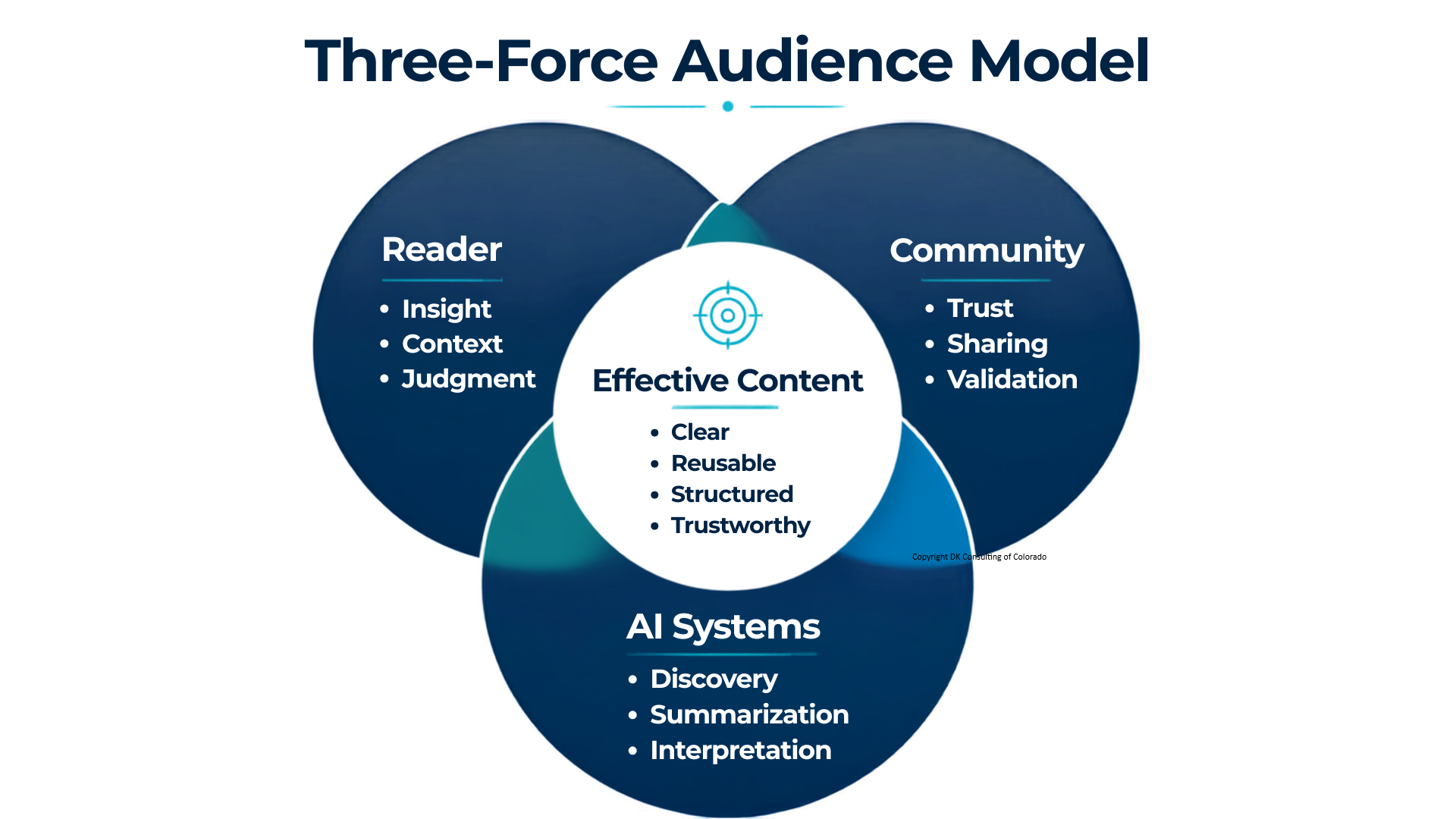
The remainder of this post explores the implications for content design and strategy of these three forces.
Beyond Designing for AI Summaries: What a Blended Approach Really Adds
In my previous blog post, “Designing Content for AI Summaries: A Practical Guide for Communicators,” I argued that communicators should begin thinking beyond designing content for traditional search engine optimization (SEO). As AI-generated summaries become a common entry point to online content, content that survives summarization becomes increasingly valuable. But additional requirements come into play when answer engine optimization (AEO) is included in a content engagement goal. So with the three-force model, a blended approach becomes more practical.
New Requirements for AEO Technical Readiness
Designing content for AEO at the technical level involves following accessibility guidelines (WAG 2.2), adhering to the structural elements, and preparing for AI-based crawlers, according to a July 2026 blog post by Stephen Jeske for Siteimprove. To prep for crawlers, Jeske recommends checking the following technical elements of your website:
- Crawl depth: Content should not be more than three clicks from your homepage.
- Page load performance: Quickly loading pages help both humans and AI crawlers process content efficiently.
- Distinct URL structure: Tags and versioning systems must distinguish current versions from older versions of the same content piece.
More importantly, five content design characteristics help make content AEO-ready as well as human-ready:
- Interpretability – The essence of the content piece must survive fragmentation without losing meaning. Jeske recommends an “answer first” approach to every section.
- Citation readiness – Sources and evidence should be visible enough to distinguish supported claims from opinion.
- Modularity – Individual sections should communicate complete ideas that can stand on their own when summarized or excerpted. (For more about writing for modularity, see my previous blog post “Step One in Component Content: Common Modules.”)
- Consistent schema – At the identity layer, the schema or markup must specify the author, publication date, content type, and brand. But don’t forget simpler mechanisms like image captions and alt text.
- Structural consistency – The content modules themselves must have a logical hierarchy, descriptive titles, clear headings, predictable organization (including repeated patterns or a recognizable template), thoughtful transitions, and meaningful metadata that help both people and machines navigate the content.
Thriving in an AEO-influenced environment requires conscious effort at every level of content design, from website design to schema enforcement to page mechanics.
Timeless Requirement for Good Content: Human Credibility
Designing content for AI does not diminish the importance of human credibility. If anything, it increases it.
Readers continue to judge content not only by what it says but by who says it. Visible authorship, transparent sourcing, and professional experience remain important signals of trust, particularly for topics involving judgment, leadership, health, finance, or other high-consequence decisions. Even Google, in its call for “people first content,” emphasizes the need for content that reflects E-E-A-T:
- Experience,
- Expertise
- Authoritativeness
- Trustworthiness
In a world beset with misinformation, it’s interesting that Google states that “trust is the most important” aspect of good content—trust being an emotional response.
Appealing to human emotions is tough for LLMs. AI-generated writing often feels polished and technically correct, yet emotionally distant. AI might answer questions accurately while offering little sense of lived experience or thoughtful reflection.
A study published by Taylor & Francis Online posits that this distance can create an emotional tax on the human reader. When content feels overly synthetic or detached, readers unconsciously spend additional mental effort deciding whether to trust it. The information may be accurate, but it lacks the subtle cues that communicate authenticity, perspective, and human judgment.
The goal, of course, is not to reject AI as a writing partner. As the Solsten article suggests, AI agents can actually assist us in understanding our human audiences. The greater challenge is ensuring that AI-assisted content still reflects the expertise, transparency, and personal perspective that readers associate with trustworthy communication.
Ultimately, AI may help people discover your content, but human credibility remains one of the strongest reasons they choose to trust it.
Solving the Audience Conundrum: What Content Professionals Must Do
If content now serves the three-force audience model, then content strategy must evolve accordingly. Success is no longer measured solely by search rankings or page views. It depends on whether content can be discovered, understood, trusted, shared, and acted upon.
For content creators, that means thinking beyond the finished article. We must begin to think in terms of modules of content. A well-designed module should function equally well when it is:
- Read in full, or
- Summarized by an AI system, or
- Quoted in a newsletter, or
- Shared through social media
Additionally, structure is more than a presentation concern; it is fundamental to the content’s usefulness. Clear headings, modular sections, descriptive titles, and visible sourcing all contribute to making ideas more durable.
Content managers should also broaden how they evaluate success. In the “Ai-verse,” rankings and click-through rates offer only superficial feedback. A piece of content that attracts visitors but fails to earn trust or encourage further engagement has limited long-term value. Increasingly, managers should look for evidence that content is being saved, cited, shared, revisited, and converted into meaningful action.
Content managers and executives must also advocate for AI governance and policy. Elements of governance include definitions of accuracy, descriptions of acceptable tone, guardrails for compliance, and requirements for engagement, according to the Forrester article authors. (For additional governance elements, review my blog post “Agent vs Agency in AI Adoption: Framing Ethical Governance.” For guidance on AI policy, review my blog post “Why Your Company Needs an AI Policy for Content Contributors.“)
Editorial teams have an equally important role. They should ask not only whether a piece is accurate and well written, but also whether it can work within all three audience forces:
- Will readers understand it?
- Can AI systems interpret it accurately?
- Does it demonstrate enough credibility and practical value that professional communities will recommend it?
These questions deserve a place alongside traditional editorial concerns such as grammar, style, and brand voice.
Ultimately, organizations should think of content as a collection of reusable knowledge assets rather than isolated publications. Articles, reports, and guides that are written with modularity in mind can be adapted for newsletters, presentations, training materials, AI summaries, and future publications without sacrificing clarity or consistency. That approach not only extends the life of individual pieces but also strengthens the coherence of an organization’s entire body of knowledge.
Finally, before publishing, ask:
- Can a reader quickly understand the main point?
- Can an AI system accurately summarize or cite the content?
- Can each section stand on its own if it is excerpted?
- Are authorship, evidence, and sources clearly visible?
- Would someone confidently recommend or share this content with others?
The goal is not to create content that merely performs well in search results. It is to create content that continues to inform, persuade, and build trust regardless of where or how people encounter it.
A New Focus: The Audience Ecosystem
The AI era has not replaced traditional audience analysis. It has expanded it.
Today’s communicators must design content that remains valuable as it passes through human readers, AI systems, and the human communities that interpret, recommend, and build upon it.
AEO is an important part of that evolution, but it is only one element of a broader discipline. The larger challenge is creating content that is clear enough for machines, credible enough for humans, and meaningful enough for communities.
Today’s communicators are no longer writing for a single audience profile. They are designing content within an ecosystem.
Disclosure: The author used AI tools to assist with research discovery, outlining, and initial drafts. The author conducted the research, finalized the outline, and wrote the final draft.
Note: The author provides no endorsement of the businesses or services mentioned in this post. This blog post was updated on Aug. 30 for consistency.
Discover more from DK Consulting of Colorado
Subscribe to get the latest posts sent to your email.
 DK Consulting of Colorado
One thought on “Rethinking Content Audiences in the AI Era: The Three-Force Audience Model”